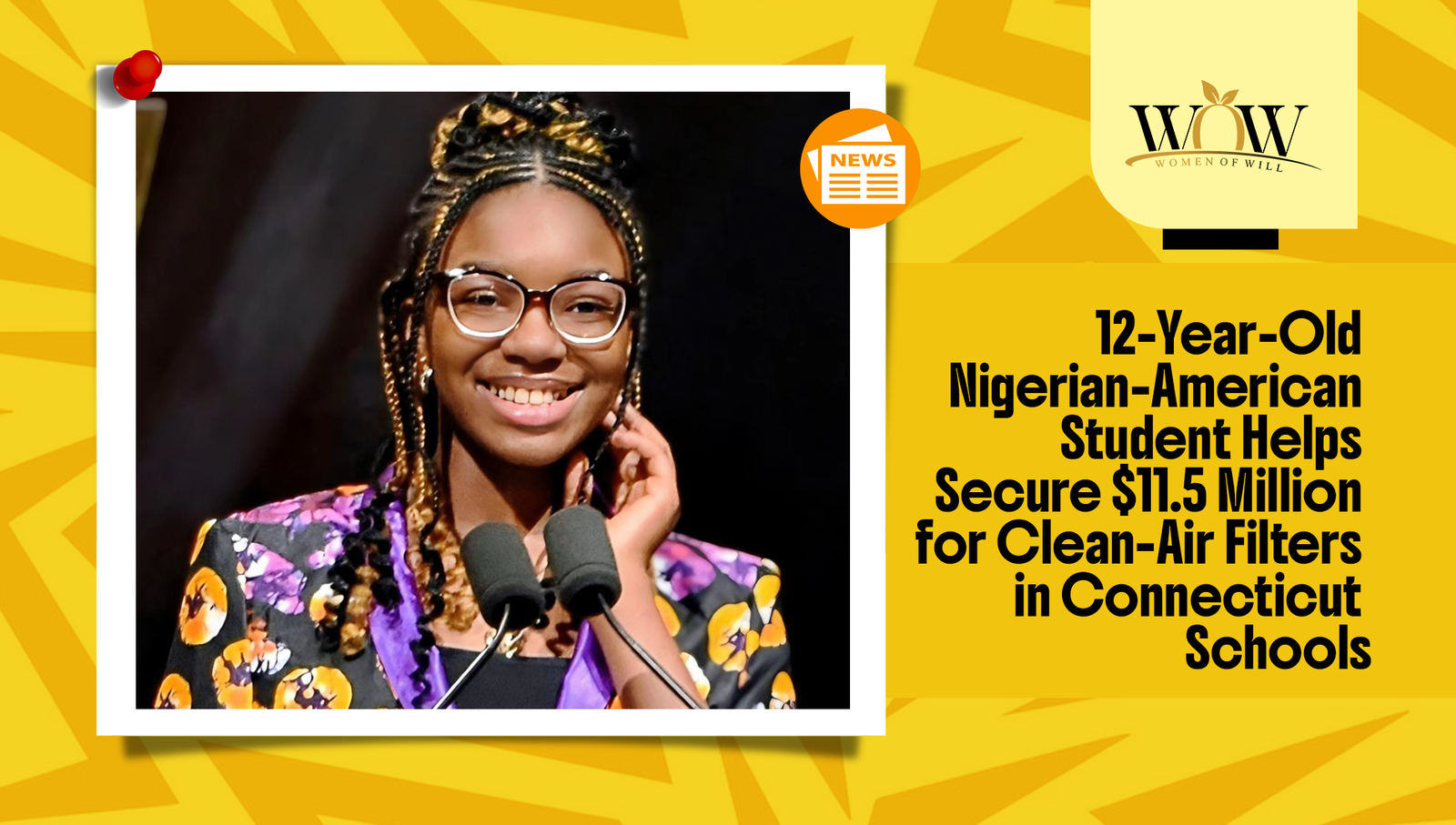
Eniola Shokunbi, a Nigerian-American student from Connecticut, is gaining recognition for championing an inexpensive classroom air-filtration solution that has helped secure $11.5 million in state funding for public schools across the state.
Shokunbi began her clean-air campaign while she was still in elementary school after becoming concerned about the quality of air in classrooms and the impact of airborne illnesses on students. She reached out to scientists at the University of Connecticut (UConn), asking for assistance in building low-cost air filters that could be used in schools.
Her initiative grew into a collaboration with UConn’s Indoor Air Quality Initiative, where scientists worked with Shokunbi and her classmates to build Corsi-Rosenthal box air purifiers. The devices can be assembled using readily available materials, including a box fan, furnace filters, cardboard and duct tape, at a cost of about $60 per unit.
The filters were subsequently tested in collaboration with the U.S. Environmental Protection Agency (EPA). Testing found that the devices could remove more than 99 percent of infectious respiratory aerosols from the air within 60 minutes, demonstrating their potential as a relatively inexpensive way to improve indoor air quality.
The project reached a major milestone in October 2024 when Connecticut’s State Bond Commission unanimously approved $11.5 million to support the construction and installation of the filtration devices in public school classrooms throughout the state. Shokunbi was present when the funding was approved.
The funding is being administered through UConn’s statewide indoor-air-quality initiative and is intended to make the low-cost filtration technology available across Connecticut’s public schools.
Beyond reducing exposure to airborne viruses and bacteria, the initiative is expected to contribute to healthier learning environments. UConn researchers have linked improved classroom air quality with reduced absences associated with respiratory illnesses and asthma, as well as potential improvements in academic performance.
For Shokunbi, however, the project extends beyond air filtration. She wants students to participate directly in building the devices, turning the initiative into a hands-on learning opportunity that encourages young people to explore science, technology, engineering, arts and mathematics (STEAM).
Her personal website says her goal is to eventually take the initiative beyond Connecticut and help classrooms across the United States and around the world gain access to affordable clean-air solutions. She also hopes the project will encourage more young people, particularly girls, to see themselves as capable participants in science and innovation.
Shokunbi’s story has consequently become an example of how a young person’s curiosity and determination can develop into a community-wide initiative. What began with a student’s concern about the air in her classroom has evolved into a multimillion-dollar state-supported programme aimed at creating healthier schools while giving students practical exposure to STEAM education.
Her achievement also highlights the power of collaboration between young innovators, educators, scientists and government—demonstrating that age does not have to be a barrier to identifying problems and helping develop solutions.
0 Comments